Be yourself; Everyone else is already taken.
— Oscar Wilde.
This is the first post on my new blog. I’m just getting this new blog going, so stay tuned for more. Subscribe below to get notified when I post new updates.
Be yourself; Everyone else is already taken.
— Oscar Wilde.
This is the first post on my new blog. I’m just getting this new blog going, so stay tuned for more. Subscribe below to get notified when I post new updates.
This week, I read Jonathan Lethem’s essay titled “The Ecstasy of Influence,” and I was surprised by one of his assertions: Everyone is a plagiarist to some extent. Lethem explained that since we are constantly being influenced by everything and everyone around us, the ideas we consider to be completely original have been inspired by someone else. Thus, when we use these ideas, we are technically plagiarizing. While it is still wrong to steal large amounts of someone else’s work, Lethem demonstrates that it is okay to take bits and pieces from other people by using the words of authors, musicians, filmmakers, etc. to write most of his essay. According to Dustin Edwards, author of the article “Framing Remix Rhetorically: Toward a Typology of Transformative Work,” Lethem’s essay is a remix since it is built by using materials that were already in existence.
I was amazed that Lethem constructed most of his essay by using other people’s words. Apparently, the essay would be categorized as a “collage text,” which makes sense, given that a collage is also made by using materials that are already in existence. I had never heard of a collage text before reading Lethem’s essay, and I didn’t know that it was permissible to plagiarize in this way. “The Ecstasy of Influence” was very eye-opening because it showed me that it is acceptable to use other people’s ideas fairly, and it is necessary if we want art, music, literature, etc. to keep progressing.

Welcome back to my blog!
Recently, I have been learning about podcasts, and I have been tasked with making one of my own. Since I have never made one before, I figured it couldn’t hurt to turn to the internet to pick up some additional tips. I found a helpful article from National Public Radio’s website called “Starting Your Podcast: A Guide for Students.” A lot of the information was a review of what I had already learned in class. For example, the article said to do research in advance and to prepare questions for anyone you are interviewing; it also reiterated that all you need to make your own podcast is a smartphone and a computer with audio editing software. Even though most of the information was not new to me, I did like that the article was a bit of a checklist for how to make a podcast, and it was good to be reminded of some of the key points I learned in class. Furthermore, I thought it was great that the article offered additional resources that would be useful for someone making a podcast, such as the link to Audacity’s website and links to a variety of podcasts. Overall, the article was straightforward, and it helped me think of a few new ideas for my upcoming podcast episode! I encourage you to check out the article if you want to know more!
Hello! Welcome back to my blog!
First, before we jump into talking about universally designed websites, let’s discuss the definition of universal design, so we can get a general understanding of what it means. Universal design is “The design of products and environments to be usable by all people, to the greatest extent possible, without the need for adaptation or specialized design.” For example, stairs are not a universal design because people who use crutches, wheelchairs, canes, etc. can’t climb them easily, if at all. On the other hand, a ramp is a universal design because everyone can use it. If a product or environment has a universal design, no one will be excluded from using it.
Website designers also want to give their websites a universal design to make it more user-friendly. Whether someone is designing a website, a building, or a product, they would be wise to use the principles of universal design as a guide. Although there are seven principles, I think four in particular should be applied to website design. If designers keep the following four principles in mind when creating their website, the majority of people should be able to better use and understand it.
Websites should have a user-friendly, universal design that clearly conveys its information. Following the principles of universal design during the creation process helps make this goal a reality.
This week, I read the first chapter of a book called Algorithms of Oppression: How Search Engines Reinforce Racism, which was written by Safiya Umoja Noble. The chapter says that search engines perpetuate racist and sexist stereotypes about women, particularly African American women. When Noble googled the phrase “Why are black women so,” Google automatically filled in results such as “mean,” “angry,” “loud,” and “attractive.” Similarly, when she entered the phrase “Why are white women so,” Google suggested words like “pretty,” “beautiful,” “mean,” and “easy.” Google’s algorithms are prolonging stereotypes that women have been trying to resist, and no one seems to doing anything about it. When I googled the word “beautiful,” pictures of women were the main result, though I didn’t google the word “women.” The employees currently working at Google must be white men who do not have an issue with seeing women sexualized on their computer screens. The solution, then, is to hire more women at Google. Women can clearly explain to the men in power why the search results are not appropriate, and they can work to change the algorithms. In the meantime, we need to make sure the public is aware of the faulty, biased system. Even though it has been repeated time and time again, many people still don’t know the general rule of thumb when it comes to the internet: that you should not trust everything you see. Additionally, just because an article or a picture is the first search result does not mean it is the best or most credible; advertisers have paid to put it at the top. I am disappointed that Google hasn’t done more to fix this problem, but I am glad there are women like Noble who are exposing the issues and calling for change.

A discourse community can be defined as a “group of people who share certain language-using practices.” There are six criteria a group must meet to be considered a discourse community: common goals, forum, provide feedback and information, shared discourse conventions, specialized language, and experts and novices. For example, a fundraising organization could be considered a discourse community. Their common goal is to raise money. Their forums – meeting places where ideas are exchanged – could be face to face, online, or in writing; assemblies, conferences, discussion boards, and Facebook groups are just a few examples of the forums the fundraising group could have. The group would need to provide feedback to each other, meaning the information would flow back and forth. If someone posed an idea, such as a new location for their fundraising headquarters, someone else would need to respond by agreeing with the idea or challenging it. Next, the group would have to have shared discourse conventions, which is another way of saying shared genres. The group might choose personal narratives as one of their genres; painting a detailed picture of why the group needs the money could convince people to donate. The group would use a specialized language that related to their fundraising efforts; maybe they would use terms, codes, and abbreviations that only members of the group could understand. Finally, the group would have experts and novices. The experts would be people who have been in the group longer; they know how to manage the operation and how to train newcomers. The novices, on the other hand, would be the newcomers to the group; the experts would have to show them the ropes.
In discourse communities, there are stylistic conventions and canonical knowledge. Stylistic conventions regulate social interactions within the group and with outsiders. Canonical knowledge regulates the worldviews of the members; the members must subscribe to the same beliefs before they are permitted to join the group. Each individual’s worldview is shaped by his/her personal experiences, opinions, beliefs, and identities, among other things. Worldviews have the power to shape discourse communities, but they can also cause clashes. For example, the fundraising group might be trying to raise money for a religious cause, yet some members of the group believe in pro-choice, which is typically seen as anti-religious; these two ideologies clash and could cause conflict among group members.
Many groups could be considered discourse communities; examples include people who all share the same college major, are a part of the same sports team, work for the same company, or live in the same apartment complex. It is normal for people to be members of many discourse communities at once. Every discourse community is unique and provides the opportunity for its members to share a special bond.
This week, I learned about typography by reading an article called “When Typography Speaks Louder Than Words.” Typography, which can be defined as “the style and appearance of printed matter,” is the visual aspect of an image; the verbal aspect, on the other hand, is the literal meaning of the words in the image. The size of the text, the font, the color scheme, and the placement of the text all contribute to the visual aspect. Graphic designers can make the visual and verbal aspects coincide to create a cohesive image, or they may decide to make them diverge to prove a specific point. There are many great examples of typography in the article, such as the picture below:
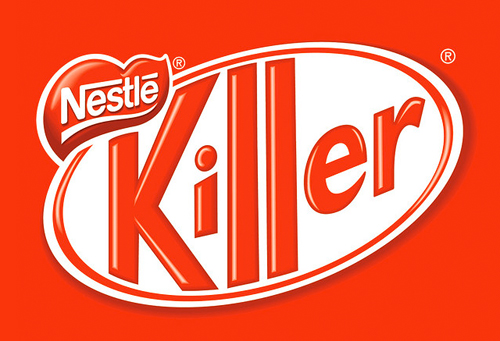
We recognize the visual as the Kit Kat logo, but the verbal message is completely different. I tried to find a few images in which the visual and verbal meanings seemed to be in alignment.
For example, the text in the picture below says, “Wake Her Up with Coffee,” so that is the verbal message. The font dances across the page, making the appearance very lighthearted and fun. The font for the word her is bolder than the fonts for the rest of the words, which separates it from the surrounding text and emphasizes it. The color scheme is light and bright, providing a sense of warmth. Additionally, the picture of the coffee cup complements the verbal message, and the hearts convey a feeling of love. The visual aspect is very cheerful and affectionate, and it seems to match the verbal aspect since we make coffee for the people we care about.

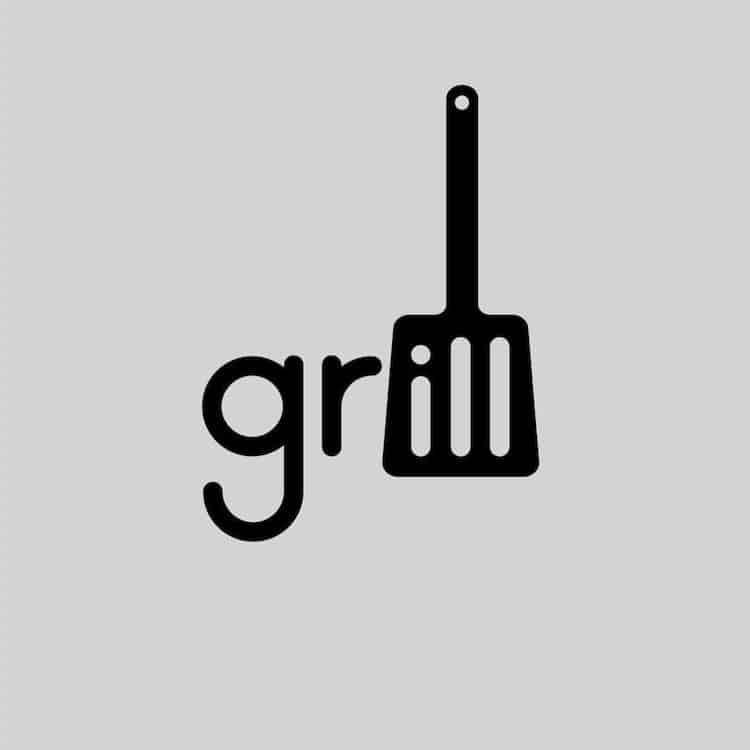
The picture below offers another interesting example. The verbal aspect is the word grill, and the visual aspect incorporates a picture of a spatula, which is an appropriate choice since it is a tool used for grilling. The visual and verbal messages coincide:
The last example is my favorite. Below, you will find various words that describe a cat, and they are arranged in the shape of a cat. The words that describe the cat are the verbal messages, while the arrangement of the words to make it look like a cat is the visual message. The words reinforce the image of the cat:
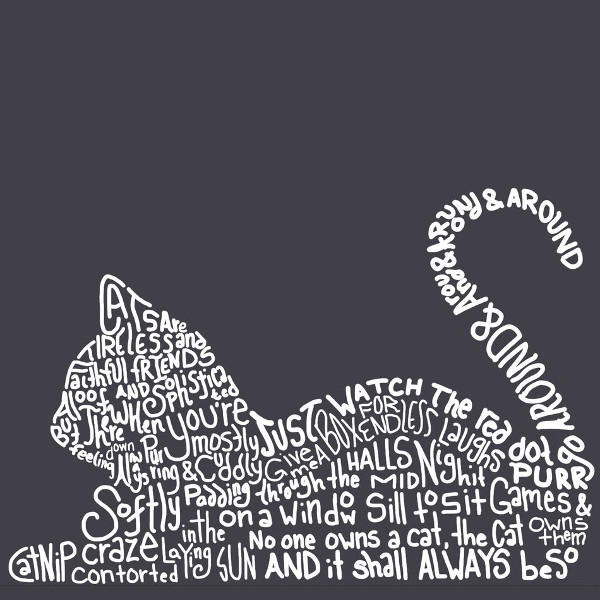
The authors say that “typographic treatment works alongside verbal language to create, alter, or enhance meaning,” and it can also “manipulate feelings and reactions.” There is no question that typography can be very powerful when delivering a message and can affect us even more than the literal words can. The visuals make us take an initial interest in the image; my eyes were drawn to the picture of the cat before I knew what the words said. Graphic designers deserve a lot of credit for all the thought and effort they put into their creations. Click the link below to check out the article if you want a more in-depth explanation of typography! https://www.smashingmagazine.com/2012/04/when-typography-speaks-louder-than-words/
Hello! Thank you for taking the time to visit my up-and-coming blog. My name is Marissa Moldoch, and I will be taking you, my readers, on this exciting new adventure. I’d like to introduce myself, so you can get to know me better. I am a Junior at Salisbury University, and I am an English major on the Writing and Rhetoric track; I am also a Communications minor. I love to listen to music, read, and write. I also have a love for all things Disney; I have been to Walt Disney World nine times! I previously published a blog on the platform Blogspot, but I have not kept up with it. Other than my forgotten blog and a few social media accounts, I don’t have much multimodal or digital writing experience. This semester, I hope to learn as many new skills as I can to take with me into future jobs. I am excited to now be able to write on my resume that I am familiar with WordPress! I am looking forward to learning how to analyze and create digital texts this semester; a job in Public Relations sounds intriguing to me, so I am hoping this class will give me the knowledge to potentially acquire a job in that field or a similar field. I am also interested in learning more about podcasts this semester. I have listened to a few, but I don’t know much about what happens behind-the-scenes. Thanks again for stopping by!
This is an example post, originally published as part of Blogging University. Enroll in one of our ten programs, and start your blog right.
You’re going to publish a post today. Don’t worry about how your blog looks. Don’t worry if you haven’t given it a name yet, or you’re feeling overwhelmed. Just click the “New Post” button, and tell us why you’re here.
Why do this?
The post can be short or long, a personal intro to your life or a bloggy mission statement, a manifesto for the future or a simple outline of your the types of things you hope to publish.
To help you get started, here are a few questions:
You’re not locked into any of this; one of the wonderful things about blogs is how they constantly evolve as we learn, grow, and interact with one another — but it’s good to know where and why you started, and articulating your goals may just give you a few other post ideas.
Can’t think how to get started? Just write the first thing that pops into your head. Anne Lamott, author of a book on writing we love, says that you need to give yourself permission to write a “crappy first draft”. Anne makes a great point — just start writing, and worry about editing it later.
When you’re ready to publish, give your post three to five tags that describe your blog’s focus — writing, photography, fiction, parenting, food, cars, movies, sports, whatever. These tags will help others who care about your topics find you in the Reader. Make sure one of the tags is “zerotohero,” so other new bloggers can find you, too.
Have a WordPress.com account? Log in now.

